

PFAS
What are PFAS?
PFAS, commonly referred to as “forever chemicals,” is an acronym for “per- and polyfluoroalkyl substances.” PFAS includes thousands of compounds that have been manufactured since the 1940s for use in a variety of household and industrial products. Two of the most widely used and studied PFAS compounds are PFOA (perfluorooctanoic acid), and PFOS (perfluorooctane sulfonic acid). The same characteristics that make PFAS compounds useful for non-stick and water proofing properties also make them resistant to breakdown and persistent in water, soils, and living tissue.
Health concerns about PFAS
Negative health effects from exposure to high concentrations of PFAS (such as during manufacture of PFAS and their use in industry) have been known for decades. Health effects from exposure to lower level exposure have been emerging more recently and include increased risk of: cancer, reproductive issues, development effects/delays in fetus and children, reduced immune function, hormone interference, and obesity. More detail is available on the Agency for Toxic Substances and Disease Registry website here and the Environmental Protection Agency website here. On the 10th of April 2024, the US Environmental Protection Agency (EPA) released a federal policy to regulate PFAS concentrations in public drinking water supplies. This policy specifically addressed five of the many thousands of PFAS compounds that exist. Details on those EPA public water supply policies are available on the EPA Per- and Polyfluoroalkyl Substances (PFAS) website.
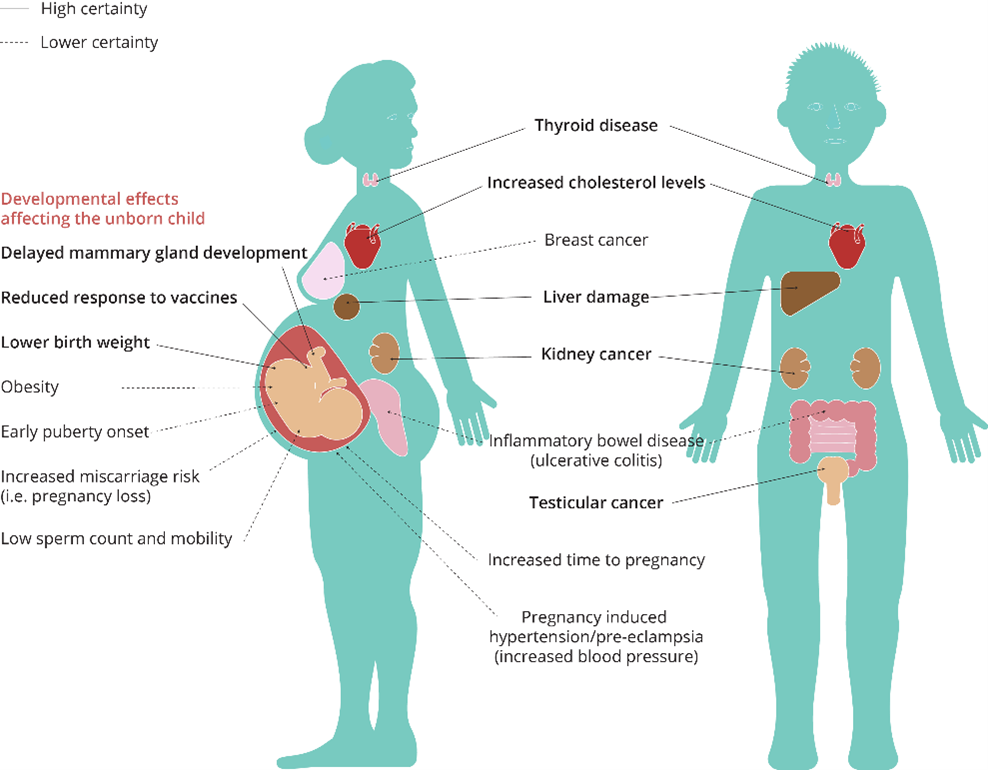
PFAS Health Effects Figure (from European Environment Agency with information from US National Toxicology Program, (2016); C8 Health Project Reports, (2012); WHO IARC, (2017); Barry et al., (2013); Fenton et al., (2009); and White et al., (2011).
Exposure to PFAS and concentrations in water
Consumer products are a common and widespread pathway of exposure to PFAS. Monitoring of PFAS in water has been relatively limited, especially in lower population states like Montana. A primary reason for limited monitoring is the high cost of analysis to detect the very low concentrations at which PFAS can be of concern. The Montana DEQ PFAS website has information on sites of concern, monitoring, FAQs, and the 2020 Montana PFAS Action Plan. In addition, the US Geological Survey (USGS) has a national website to explore data for PFAS concentrations they have measured in water. A summary of results from a 2023 PFAS private well testing project in southwest Montana is available here.
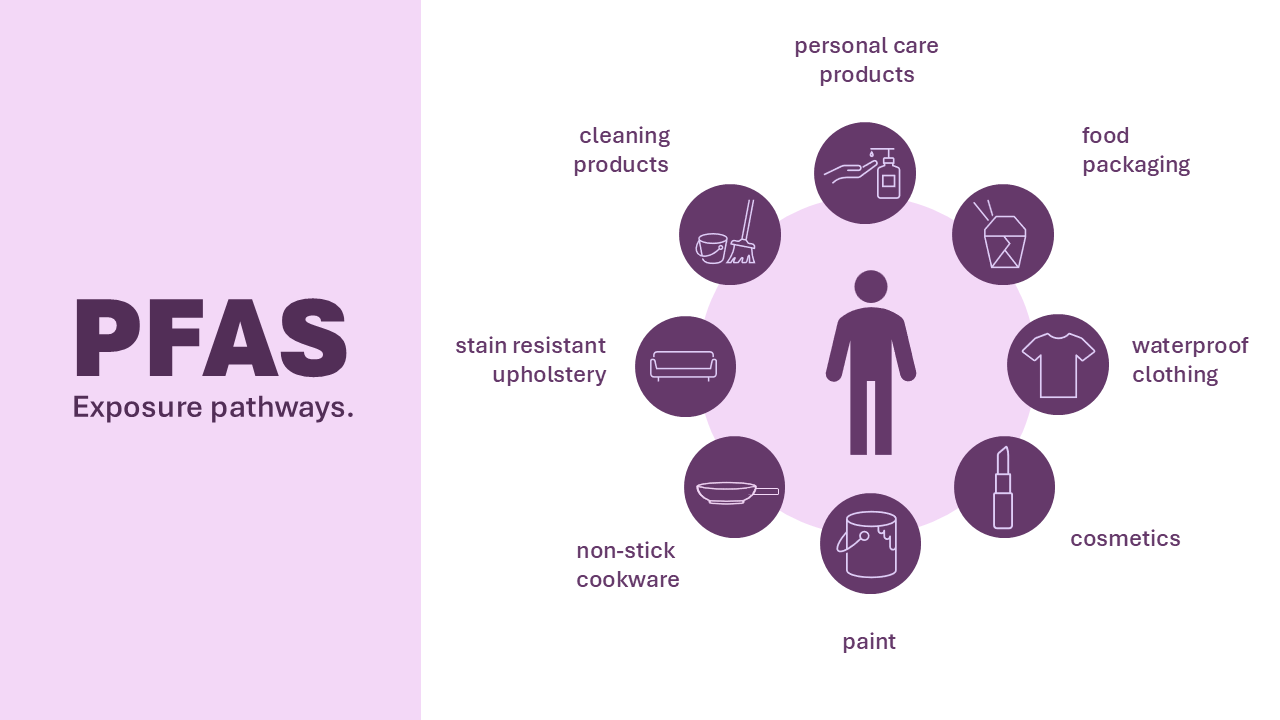
PFAS Exposure Pathways Figure (from MSUEWQ with information from the US Center for Disease Control, Agency for Toxic Substances and Disease Registry)
Testing water for PFAS
Testing water samples for PFAS is complicated by the large number of possible compounds and the low concentrations at which these compounds can be of concern. Care must be taken when collecting water samples to avoid contamination, because PFAS are present in many household products. Some certified private testing laboratories can test for PFAS. When pursuing PFAS testing it is important to understand which compounds will be tested for, which of those compounds have health thresholds, and whether the testing lab will be able to provide results that can be readily compared to thresholds with the report. Most PFAS compounds do not have health thresholds established, so it is not yet possible to understand the human health implications for concentrations of those compounds. Research and information on health thresholds is updated regularly, so check in at the EPA Per- and Polyfluoroalkyl Substances (PFAS) website for current information.
Water treatment for PFAS
Activated carbon and reverse osmosis are two commonly used treatment types that can be effective at removing PFAS, and more detailed treatment information is provided by the Environmental Protection Agency here.